

Higher bids. Fewer qualified crews. Schedules that shift without warning.
Labor risk is becoming one of the fastest ways a project can lose predictability.
Across the construction industry, companies are struggling to fill key roles, and those workforce gaps are already showing up in project timelines.
For developers, this is not just a hiring problem.
It is a cost, schedule, and preconstruction problem.
Labor-Sensitive Trades Can Drive Schedule Risk
Some trades most likely to disrupt the schedule are also among the most labor-sensitive.
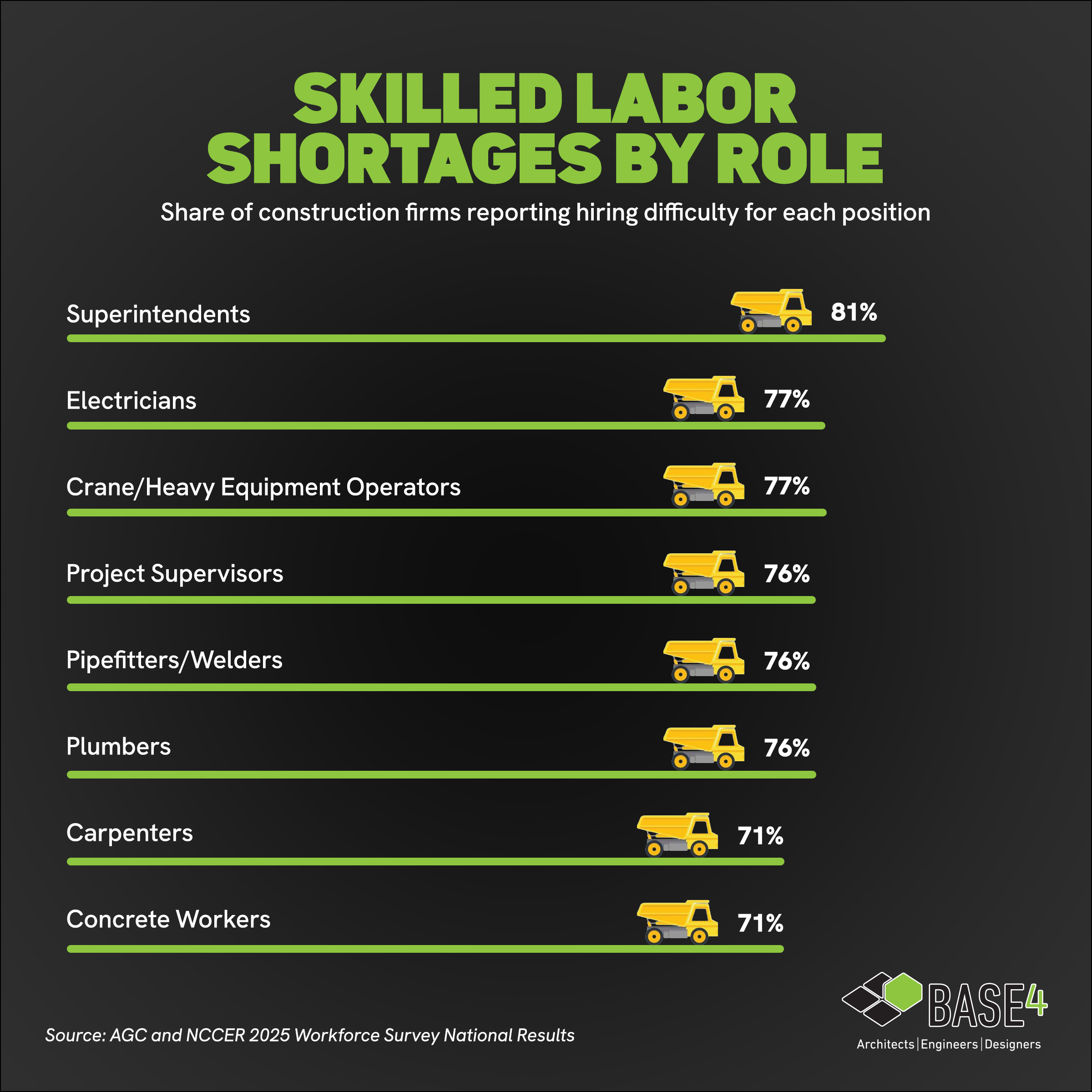
When these trades tighten, the business impact is clear:
-
Fewer qualified subcontractors bidding
-
Higher labor pricing
-
Less schedule reliability
-
Harder sequencing
-
More field coordination pressure
This is when a project that looked solid on paper can start slipping in the field.
Workforce Dependency Varies by Market
Labor dependency also changes by location.
Construction labor dependency varies by state, which can affect project exposure when labor-sensitive trades tighten.
Two similar projects can face very different pricing and schedule pressure depending on local subcontractor depth, trade availability, and how quickly the market can absorb demand.
That is why labor conditions should be reviewed before pricing and schedule assumptions are locked.

What Smarter Developers Are Doing
- Choosing systems that fit local labor depth
- Using prefab or offsite strategies where they make sense
- Coordinating MEP and structural systems before bidding
At BASE4, we treat labor as a design and preconstruction variable, not just a field issue.

Thank you,
Blair Hildahl
BASE4 Principal
608.304.5228
BlairH@base-4.com