Data centers expose bad planning faster than most building types.
Before design moves too far, the team needs to confirm the real power target, cooling approach, backup strategy, equipment loads, and expansion plan.
Why Data Centers Fail Before They Break Ground
The problems usually start in programming.
Developers underestimate power loads, cooling needs, or backup system requirements.
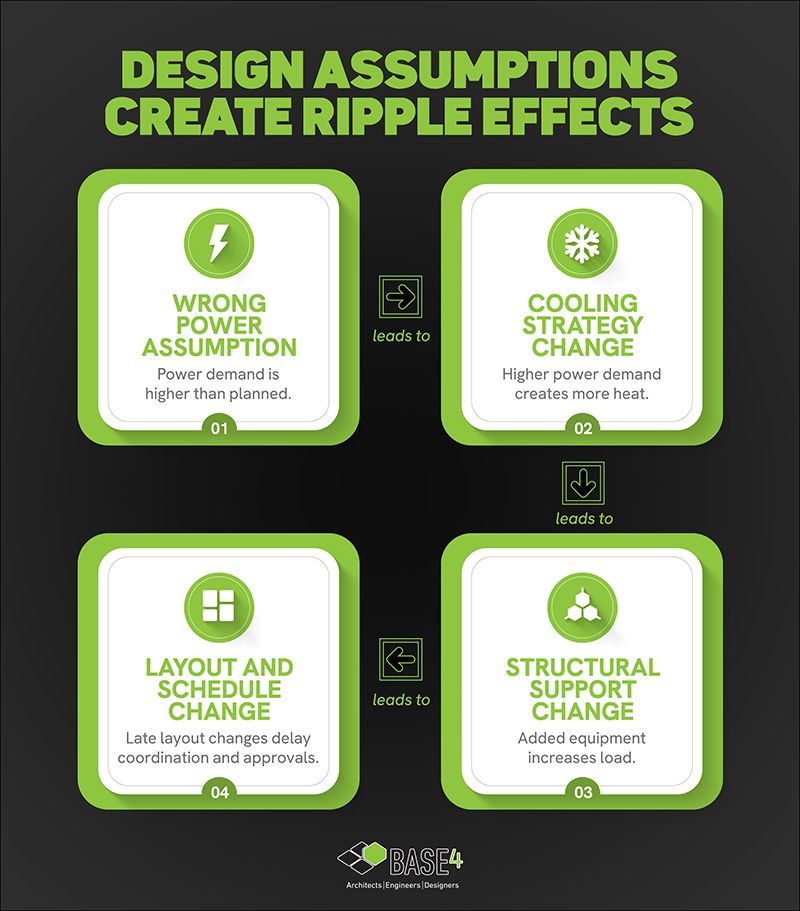
Once conflicts reach the drawings, they cost real time and money.
The earlier the assumptions are tested, the cheaper the fix.
The Systems Coordination Problem
In a data center, MEP is not supporting the building. MEP is the building.
When architecture, structure, and mechanical and electrical systems are designed by separate teams trading drawings back and forth, conflicts show up late.
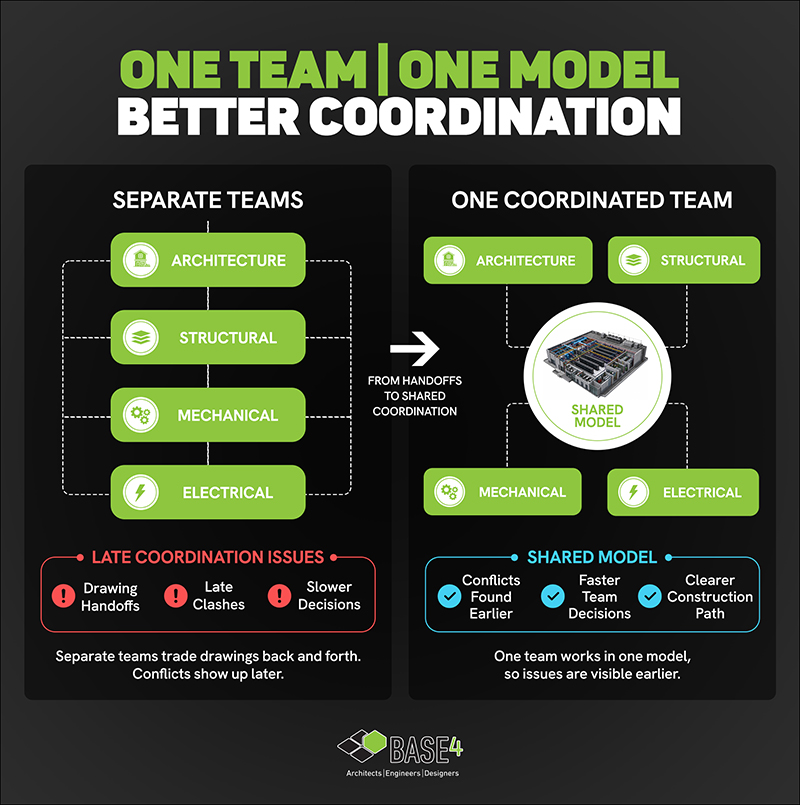
That creates RFIs, redesign, schedule delays, and cost pressure.
The better path is coordinated design from day one.
AI Demand Raises the Stakes
AI workloads often require much higher power per rack than standard enterprise data centers.
IEA notes that AI is increasing the use of high-performance servers, which raises power density in data centers.
That is not a small adjustment. It changes your structural loading, your cooling strategy, and your generator capacity.
Many developers are still applying yesterday’s assumptions to a fundamentally different product.
If your design is not built around actual AI workload requirements, you are already behind.
How BASE4 Approaches Data Center Projects
Data centers need one coordinated team, not separate teams trading drawings back and forth.
How BASE4 reduces data center design risk:
- In-house architecture, structural, MEP, interiors, and visualization
- 100% Revit and 3D coordination from the start
- Early planning that tests power, cooling, equipment loads, backup systems, and future expansion together
- Cost-aware design that tests assumptions before they become problems
- Prefab and offsite expertise where factory precision helps
- Clear documentation for lenders, owners, and project teams
Developers get a coordinated design that is easier to price, easier to build, and less likely to change late.
If you are planning a data center project, test the assumptions early, before they cost you time.

Thank you,
Blair Hildahl
BASE4 Principal
608.304.5228
BlairH@base-4.com