Student housing still has demand, but developers need a sharper strategy than before.
The right markets remain strong, and well-located projects can still outperform.
But developers need to evaluate rent growth, preleasing, supply, on-campus demand, and product fit before design begins.
Student housing only pencils out when market and design strategy align early.
Rent Growth Can No Longer Carry the Deal
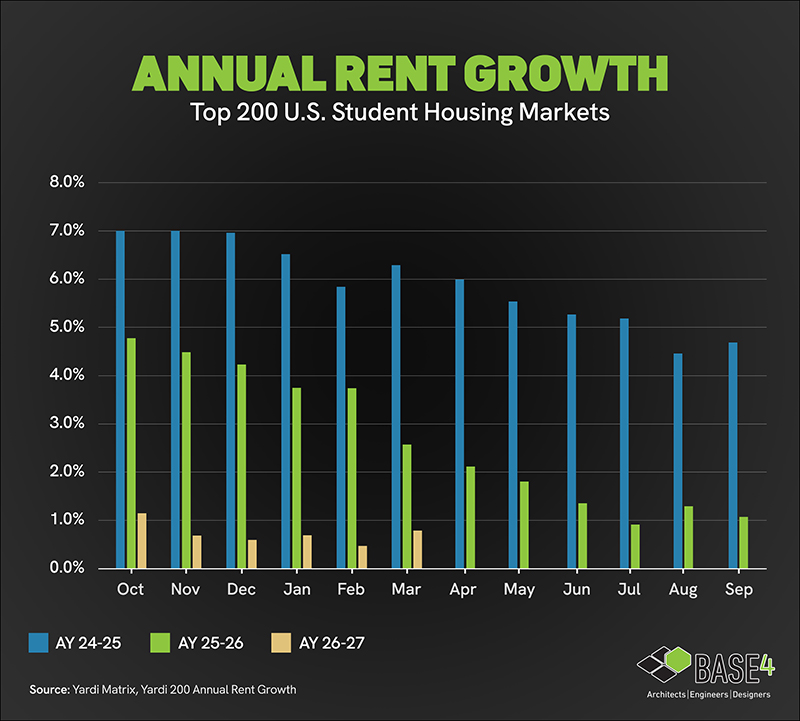
- According to Yardi, average rent growth across the Yardi 200 slowed to 0.8% year-over-year in March 2026, well below 2.6% in March 2025 and 6.3% in March 2024.
- Preleasing is ahead nationally, but markets like Purdue, Arkansas, UCF, NC State, and the University of Tennessee are trailing. New supply is a major reason.
Deals need to work at today’s rents. That math starts in planning.
Enrollment Headlines Can Be Misleading
Enrollment growth matters, but it does not guarantee strong lease-up, rent growth, or the right unit mix.
Online enrollment can grow while physical attendance stays flat.
Housing demand follows students on campus, not headcount on a report.
In secondary and tertiary markets, especially, verify on-campus demand before treating the numbers as a green light.
Strong Schools Can Still Be Oversupplied
A strong university does not mean a strong market.
Florida State alone is delivering over 2,600 beds this fall. Tennessee, NC State, and Arizona State each top 2,000.
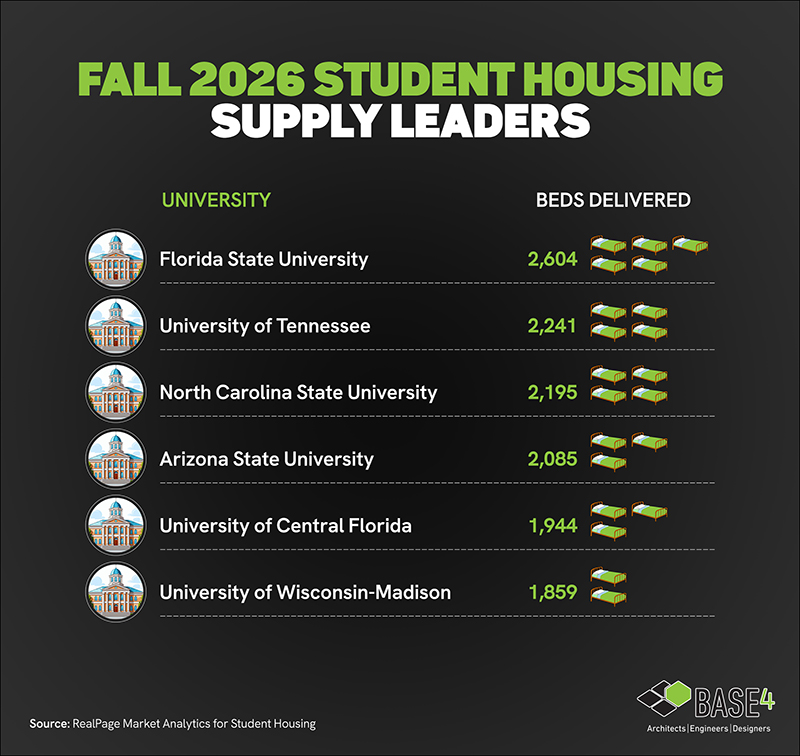
When that much supply lands at once, lease-up slows and concessions rise.
Where Student Housing Still Pencils
- The best markets share one trait: on-site enrollment is growing faster than new supply. Ole Miss, Auburn, UT San Antonio, Texas State, Kennesaw State, LSU, and San Jose State stand out.
- Location still matters. Beds within a quarter mile of campus command the highest rents, while mid-rise and high-rise projects are leading preleasing.
- Farther sites can still work, but only with tighter layouts, lower costs, and a clear reason for students to choose them.
The Next Cycle Will Be Won in Planning
Even a strong student housing deal can miss if the product, timing, and assumptions are not aligned from the start.
BASE4 helps developers test the deal early with:
- Cost-aware design tested against real pro formas
- Unit mix and amenity load calibrated to today’s rents
- Prefab and offsite expertise for faster, cheaper delivery
- In-house architecture, structural, MEP, and interiors
- 100% Revit coordination to reduce field errors and delays
- Early planning before weak assumptions get locked in

Thank you,
Blair Hildahl
BASE4 Principal
608.304.5228
BlairH@base-4.com