Most developers enter the data center space thinking they are building a commercial project.
They are not.
Data centers are specialized buildings with very strict power, cooling, and uptime requirements, and the budget gap between them is where most projects fall apart.
What It Actually Costs to Build a Data Center Right Now
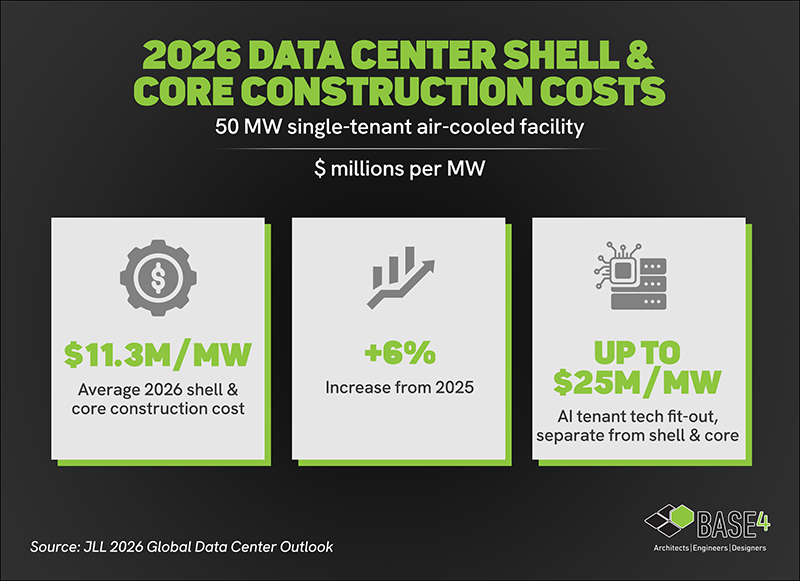
According to JLL, average global shell and core construction costs in 2026 are running about $11.3 million per MW, up 6% from 2025.
That figure covers the building only. Land, IT equipment, and tenant fit-out are not included.
For AI infrastructure, tenants handle their own fit-out, which can add up to $25 million per MW on top of that.
And that’s before any delays, overruns, or design changes. The final number almost always goes higher.
Where the Budget Actually Goes
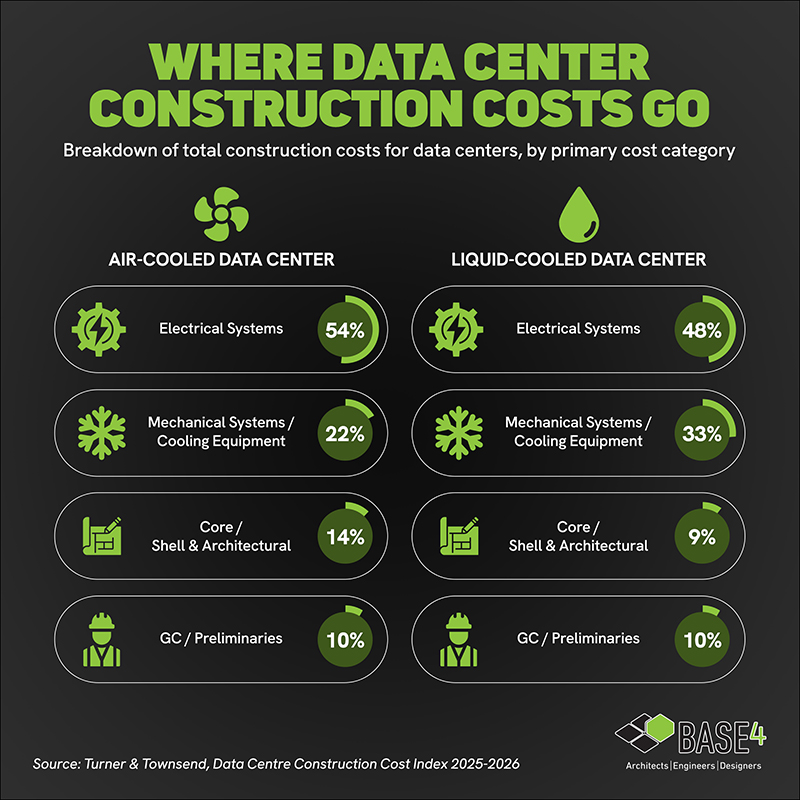
Electrical systems are the largest cost driver in data centers. Power, cooling, and uptime requirements can quickly push budgets beyond the building shell.
Mechanical systems also account for a major share, especially as cooling needs increase. That means the biggest cost risks are often tied to systems coordination, equipment decisions, and early engineering assumptions.
Most developers do not price this correctly until they are already deep into design development, which is too late to course-correct without pain.
Stalled Projects Are Expensive Projects
Carrying costs, extended preconstruction fees, and escalating equipment prices mean every month a project sits idle adds real dollars to the final number.
57 percent of data center projects experienced delays of three months or more in 2025. Power procurement, transformer lead times, and permitting are the top causes.
These are not scheduling problems. They are budget problems that started before design was complete.
How BASE4 Approaches Data Center Projects
The budget is set in the first 15 percent of design. That is where BASE4 works.
What BASE4 does differently:
- In-house architecture, structural, and MEP under one roof
- 100% Revit and full 3D coordination catches conflicts before construction
- Cost-aware design applied from the first layout decision
- Prefab and offsite strategies reduce MEP installation time and field exposure
- Early planning identifies power capacity gaps before they become change orders
- Integrated visualization helps ownership and lenders understand scope, risk, and phasing
If you are planning a project now, the right move is a scope conversation before the budget is locked. Once it is set, your options shrink fast.

Thank you,
Blair Hildahl
BASE4 Principal
608.304.5228
BlairH@base-4.com